K
Context
You prepare your knowledge, your applications, and your materials so that AI can work with them meaningfully.
My Approach
The KIAD approach helps you move beyond experimenting with AI in a chat window and build it meaningfully into your grant funding work.
AI can do an astonishing amount. It can draft project ideas, describe target groups, answer application questions, and suggest implementation plans. But in grant funding work, it's not enough for a text to sound plausible. It has to fit your organization, your local target group, your regional context, and what you can actually deliver.
That's exactly what the KIAD approach is for.
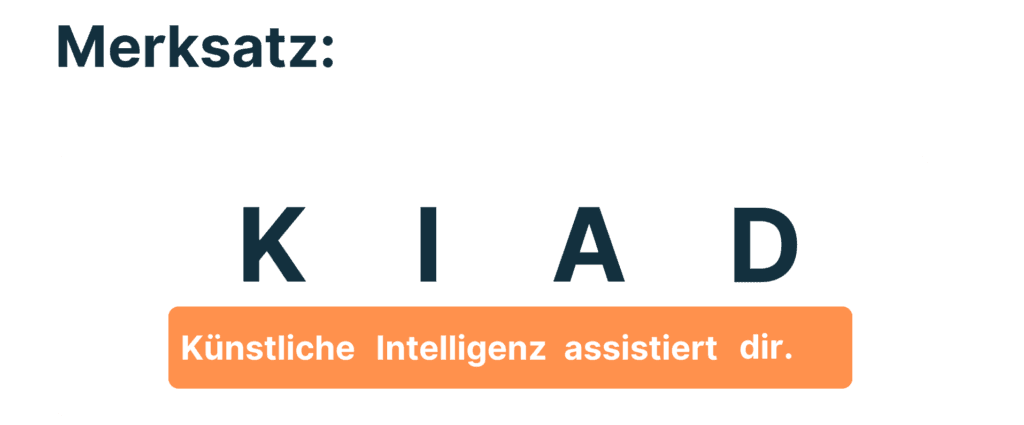
It combines solid grant craft with a clear structure for using AI: Context, Input & Interaction, Assistants, and Documentation.
Many AI results are impressive at first glance.
Suddenly a project sounds polished. The target group is neatly described. The activities seem logical. Even the tone sort of fits.
And yet something is missing.
Because a good grant application doesn't describe just any good project. It describes your project.
It has to show why your organization in particular can deliver this project. What your target group really needs. What experience you bring. What the conditions on the ground look like. Which partners are involved. What has already been tried. And why this application fits this exact funding program.
AI can support all of this very well.
But it needs your groundwork first.
If you don't give it context, it fills the gaps on its own. The result: texts that may sound professional but remain interchangeable.
This is exactly where the KIAD approach comes in: it helps you bring AI into your work in a way that makes your expertise more visible, not less.
Key takeaway
AI shouldn't write just any application. It should help you develop your application — better, clearer, and faster.
The KIAD approach wasn't designed on a drawing board.
It comes out of my KI-Accelerator cohorts with nonprofit organizations.
After one of the first cohorts, I had many one-on-one conversations with participants. I wanted to know: What did you really learn? What are you taking with you? What helped you in your day-to-day work? And where did “interesting” actually turn into “useful”?
Certain points kept coming up.
It wasn't the one perfect tool that made the difference. Nor the one perfect prompt.
What made the difference was that organizations understood how much good context matters. That they learned to work with AI in dialogue. That they could translate recurring tasks into their own assistants. And that they documented what worked, so that not everything starts over with every new application.
KIAD grew out of these recurring experiences: a simple roadmap for using AI in practical grant funding work.
Key takeaway
KIAD is not a theoretical model. It's the distilled experience of real applications, real organizations, and real learning processes.
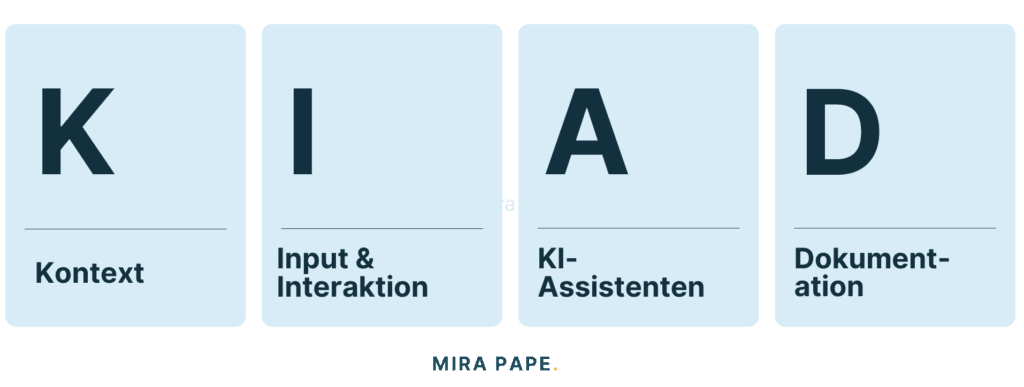
The order matters.
Many people start straight with prompts or tools. Understandably — that's where you see results fastest.
But without context, even good prompts stay limited. If the interaction is unclear, results don't get better. If recurring tasks aren't set up properly, AI remains a fresh experiment every single time. And if nobody documents what works, a lot of knowledge disappears back into individual chats.
KIAD helps you use AI not as a collection of isolated tricks, but as a way of working.
You prepare your knowledge, your applications, and your materials so that AI can work with them meaningfully.
You learn to set good tasks, review results, and keep working with AI in dialogue.
You translate recurring tasks into assistants, agents, or skills that hold processes, ask follow-up questions, and guide you through the typical steps of your work.
You record what works so that knowledge stays usable across your team.
The results of an AI tool are only as good as the information you provide.
Grant applications are almost never about generic text. They're about your organization, your target groups, your past projects, your language, your region, your funding logic, and the requirements of a specific funding program.
That's why good AI work doesn't start with the perfect prompt.
It starts with context.
That can include, for example:
When this information is well prepared, AI has to guess less. The results become a better fit — more grounded and much closer to your actual work.
Key takeaway
Good context is the difference between a plausible AI text and a draft that truly fits your organization.
At first, many people treat AI like a better search engine.
A short question in, an answer out.
For grant applications, that's rarely enough.
If you want specific, usable results, AI needs clear tasks, good follow-up questions, and feedback. Think of it more like a new colleague who is meant to contribute professionally but first needs to understand what it's all about.
A good prompt doesn't just describe what should come out. It also explains:
And the first draft is usually not the end.
You follow up. You sharpen. You correct. You have it double-check. You ask for alternatives. That's exactly how an AI answer turns into a usable working process.
Key takeaway
Good AI work doesn't come from one perfect prompt — it comes from good interaction.
In grant funding work, many tasks come back again and again.
Structuring project ideas. Checking funding requirements. Revising application drafts. Giving feedback. Sharpening impact logic. Adjusting wording. Checking documents for gaps.
This is exactly where building your own AI assistants pays off.
Depending on the tool, they go by different names: custom GPTs, assistants, agents, skills, or workflows. The terminology is changing fast right now. But the core idea behind them stays the same:
AI shouldn't just answer individual questions — it should carry part of a process.
A good assistant knows which information it needs. It asks follow-up questions when something is missing. It reminds you of important steps. It checks whether funding logic, target group, activities, and impact fit together. And it helps you avoid starting from zero every single time.
This also changes our own role.
We no longer have to hold every single step in our heads and spell it out again and again. Instead, we build structures in which the AI system holds part of the process and asks us, at the right moments, for the information that really matters.
For example, an assistant can help with:
One thing matters: an assistant doesn't replace your judgment.
But it can prepare, sort, question, and speed up tasks that would otherwise cost you a lot of time over and over again.
Key takeaway
A good AI assistant doesn't simply write for you. It holds the process, asks better questions, and makes your expertise easier to use.
Many organizations test AI here and there.
A good prompt here. A helpful chat there. A half-working workflow somewhere in a browser tab.
The problem: if nobody records what worked, everything starts over with the next application.
That's why documentation is a fixed part of the KIAD approach.
Documentation doesn't mean writing enormous manuals. It's about making the most important lessons usable:
That way AI doesn't just make life easier for individual people — it becomes a way of working that the whole team can share and build on.
And precisely because many organizations are developing their own tools, policies, and ways of working, this step keeps getting more important.
Key takeaway
Documentation turns individual AI experiments into a reliable way of working.
Examples
An organization collects successfully submitted grant applications and prepares them so that AI can recognize typical structures, phrasings, and project logic. The result: new drafts that are much closer to the organization's own language and way of working.
An assistant supports the writing process by keeping relevant guidelines, program logic, and formal requirements in view. Individual sections can be reviewed and sharpened far more precisely.
A dedicated assistant reviews application drafts against typical criteria: clarity, funding logic, impact goals, gaps, formal requirements, and fit with the target group.
The KIAD approach is especially helpful if you see grant funding work not as a one-off task, but as a recurring process.
It's a good fit if you:
The approach is less suitable if all you want is a quick prompt that writes a finished application for you without any context.
Because that's exactly what this is not about.
Not every offer on this platform covers the entire KIAD approach.
That's deliberate.
The beginner courses are there to help you build confidence with ChatGPT and other AI tools first. They cover foundations, orientation, and first meaningful use cases. KIAD plays a marginal role there at most.
In the live seminars, we pick up individual building blocks from the approach. Sometimes the focus is on context, sometimes on good prompts, sometimes on assistants, agent skills, or concrete workflows. Other formats center on documentation, internal knowledge sharing, or the question of how AI can be integrated responsibly into existing workflows.
The most comprehensive KIAD format so far has been the KI-Accelerator. Over six weeks, we connected all four steps: preparing context, developing prompts, building assistants, and documenting the work with AI.
The Accelerator will not take place in 2027.
During this time, the closest you can get to the KIAD approach is through Momentum. There you get access to the Fokus-Seminare, selected digital products, and materials on the platform. That way you can put together the individual building blocks of the approach step by step and go deeper wherever it fits your work right now.
Momentum also includes a guide that shows which offers belong to which area of action: What helps you get started? What supports you in building context? Where do prompts, assistants, or skills come in? And which materials help you document and share AI within your organization?
For the platform, that means:
You don't have to implement the whole system right away.
You can start with the building block that fits your work right now: a better start, a good context document, a clearer prompt, a first assistant, or a simple form of documentation for your team.
You don't have to rebuild everything at once.
One good next step is enough: better context, a clearer prompt, a first assistant, or simple documentation of what works.
Over time, that's exactly what grows into a way of working that genuinely takes weight off your shoulders.
Prefer to keep reading along for a while? Sign up for the newsletter.
Mit der Anmeldung stimmst du dem Erhalt des Newsletters zu. Du kannst dich jederzeit über den Link in jeder E-Mail abmelden. Weitere Infos in der Datenschutzerklärung.